Showing posts with label Olympics. Show all posts

Thursday, September 11, 2008

Don't Drink and Jump...

Russian Ivan Ukhov faces a year ban after he competed at the Lausanne Grand Prix a week ago ... while very drunk.

The 22-year-old high jumper, one of Russia's best, was upset after failing to qualify for the Olympics. A big fight with his girlfriend apparently pushed him over the edge and he hit the bottle hard.


Here's the moment that will likely define Ivan for the rest of his life:


Sunday, August 31, 2008

YouTube's Best Sport Videos of the Week - Aug 24th to Aug 31st

Another week, another post of the best sports clips on the net. With the Olympics finished, baseball wrapping up the dog days or summer and the NFL, NHL and NBA yet to start it's a bit of a down time in the world of sport. We had to look extra hard but we found a few nuggets out there for you:


  • Not one, but two, sportscasters deciding to dedicate time from their shows to discuss the possibility of Usain Bolt coming to the NFL. Ridiculous.

  • The official trailer for NHL 09 featuring a digitized Dion Phaneuf. We want one.

  • An amazing fight between a female cop and a drunk female fan at Yankee Stadium. We guess tensions are running high with the Yankees close to elimination.

  • Real Men of Genius: Mr. Fantasy Football Manager Guy. We love the line: "You were born with the one skill every manager needs to player fantasy football...absolutely no skill playing actual football." It's funny, cause it's true.

  • In September, Playboy will be sending out their NFL picks directly to your cell phone. We went to their website to see what this was all about but we got side tracked.

  • And this week's Clip O' The Week is from the the Redeem Team celebrating after their gold medal win. All normal until the 50 second mark, where it seems King James is either really drunk or doesn't know his own anthem:

< Last Week <> Next Week >

Sunday, August 24, 2008

Bizarre Olympic Moment - Day 16

Each day of the 2008 Olympics we've found a bizarre clip or story from a past Summer Olympics. Today, in the last day of our series, we'll look at the 1960 Tunisian Modern Pentathlon Team.

We'll finish up our Bizarre Olympic Moments segment with the most obscure story on our list. One of the most unique sports at the Olympics is the Modern Pentathlon. Competitors must demonstrate their skills in five areas: shooting, swimming, fencing, horse riding and running.

"Baron Pierre de Coubertin founded the modern pentathlon believing the event would test a man's/woman's moral qualities as much as his physical resources and skills, thereby producing the ideal, complete athlete. " (From www.modern-pentathlon.com)
A complete athlete needs to be an expert at fencing apparently. We won't critique the merits of the sport as we wouldn't want to offend the four or five fans of the Modern Pentathlon.

Our purpose for this post is to look at one of the worse performances of any team in history. At the 1960 Rome Olympics Tunisia sent three athletes to compete in the Pentathlon. In the individual competition they finished in 56th, 57th and 58th. Dead last. One of the Tunisians, Ahmed Ennachi, took more than 17 minutes to finish the riding portion (the next longest was 10 minutes).

Surprisingly, the Tunisians found a way lower the bar even further in the team competition.

First up was the riding portion. Things did not start out well as all three competitors fell off their horses. The team was given a historic score of zero.

The swimming was the second event that the team would need to struggle their way through. The Tunisians scored a 1,260 which is impressive when you consider that one of the team couldn't swim and almost drowned in the competition.

Third up was the shooting. The Tunisians finished with a 1,340 just a 140 points behind Germany. They may have finished ahead of Germany if one of the team wasn't removed from the competition after he almost shot an official.

Things didn't look any more hopeful for the fencing as only one of the three Tunisians knew how to fence. The team hoped nobody would notice if they sent the same team member up three times with his helmet on. Officials did notice and they were awarded a paltry 768 points (second last Great Britain had 1,700).

The final event was the cross-country run. Tunisia finished strong (well, relatively speaking) and scored their highest score of 1,758 ... we guess it's pretty hard to mess a run up. They still finished in last place, but only by 350 points.

Other than Tunisia, every country finished with a score between 10,000 and 15,000. The total score for Team Tunisia was only 5,126 marking one of the worst performance by a team in Olympic history.

Maybe if Tunisia had this guy cheering for them they could have finished in second last. Somebody needs a hobby. Aim, Aim, Shoot!


(Information for this article was taken from a great article in the Herald)


Take a look at the 16 most bizarre Olympic moments in history:

Day 1 - Eric "The Eel" Moussambani
Day 2 - Betty Robinson
Day 3 - Sally Robbins
Day 4 - Abebe Bilkila
Day 5 - 1972 USA Basketball team
Day 6 - Bobby Pearce
Day 7 - Byun Jong-il
Day 8 - Stella Walsh
Day 9 - Spanish Paralympic Basketball Team
Day 10 - Ingeborg Marx
Day 11 - Vanderlei de Lima
Day 12 - Hans-Jurgen Todt
Day 13 - Liu Changchun
Day 14 - Dorando Pietri
Day 15 - 1956 Hungarian Water Polo Team
Day 16 - 1960 Tunisian Modern Pentathlon Team

YouTube's Best Sport Videos of the Week - Aug 18th to Aug 24th

Each week at Waikiki Hockey we do our best to round up all the videos that fell through the cracks during the week.

< Last Week <> Next Week >

Saturday, August 23, 2008

Bizarre Olympic Moment - Day 15

Each day of the 2008 Olympics we're going to find a bizarre clip or story from a past Summer Olympics. Today we'll look at the 1956 Hungarian Water Polo Team.

The 1956 Melbourne Games are known for hosting one of the most infamous events in Olympic history.

The Hungarian water polo team was considered to be the best in the world. While training for the upcoming Summer Games in Melbourne an uprising against the Soviet rule began in Hungary. The team was moved to Czechoslovakia to complete their training away from the turmoil. When they finally arrived in Australia they learned that Russian troops and tanks rolled into Budapest and had brutally dealt with the uprisers. Many of the players realized it would be unlikely they would return back to Hungary at the conclusion of the Olympics.

Even with a war going on in their home country Hungary still decided to complete. They won their the opening rounds of the games which meant the team would play the Soviet team in the semi finals.

The Hungary-Russian water polo match has recently been compared by some media outlets to the recent Georgia-Russia beach volleyball match.

Comparing the volleyball contest to what the Hungarians went through it a bit of a joke by the media. Water polo is a contact sport for one. Also, the two Georgian volleyballers were born and raised in Brazil and have only been to Georgia twice. The volleyball match was something completely different than what happened in 1956.

The Hungarian water polo team thought this game would be a small way for them to regain some pride for their fellow countrymen:
"We felt we were playing not just for ourselves but for our whole country" said
Hungarian Ervin Zádor after the match
The was a physical affair right from the opening minutes with verbal barbs, kicks and punches being traded between the two teams. Hungarian Dezso Gyarmarti caught a Russian with a sucker punch, This helped to get the mostly Hungarian expatriate crowd into a frenzy.

With only a few minutes left, and Hungary winning 4-0, Russian Valentin Prokopov smashed Zador in the face with a massive right hook. The punch left a deep gash above his eye. When the crowd saw their star player with blood flowing down his face they nearly rioted. Zagor was forced to leave the game due to the injury causing many spectators to jump onto the pool deck and shout abuse and spit at the Russians.

Police calmed the crowd and with one minute remaining the game was called and Hungary was awarded the win.

Pictures of Zador leaving the pool with blood trickling down his face graced the sports pages of papers around the world. The media dubbed it the “Blood in the Water” match, although reports that the water turned a blood colour were an over-exaggeration.

Hungary won the gold medal match against Yugoslavia 2-1 to win their fourth Olympic Gold. After the Olympics, half of team defected to escape the turmoil that that been occuring in their homeland.

In 2006, the epic match had been made into a documentary. Freedom’s Fury that was produced by Lucy Liu and Quentin Tarantino and narrated by Mark Spitz. Here's the trailer:


(Information from this article was taken from Nation Master and Sports Illustrated)


Take a look at the 16 most bizarre Olympic moments in history:

Day 1 - Eric "The Eel" Moussambani
Day 2 - Betty Robinson
Day 3 - Sally Robbins
Day 4 - Abebe Bilkila
Day 5 - 1972 USA Basketball team
Day 6 - Bobby Pearce
Day 7 - Byun Jong-il
Day 8 - Stella Walsh
Day 9 - Spanish Paralympic Basketball Team
Day 10 - Ingeborg Marx
Day 11 - Vanderlei de Lima
Day 12 - Hans-Jurgen Todt
Day 13 - Liu Changchun
Day 14 - Dorando Pietri
Day 15 - 1956 Hungarian Water Polo Team
Day 16 - 1960 Tunisian Modern Pentathlon Team

Friday, August 22, 2008

Bizarre Olympic Moment - Day 14

Each day of the 2008 Olympics we're going to find a bizarre clip or story from a past Summer Olympics. Today we'll look at Italian Marathon Runner Dorando Pietri.

In 1896, at the first modern games in Athens, the showcase event was the marathon. The event was created to commemerate a historic moment in Greek history. In the 5th century BC, a man named Phidippides ran 39km from the battlefield back to Athens to declare victory and then dropped dead.

At the 1908 Olympics in London the marathon was extended to it's current length of 26 miles and 385 yards. The reason for the extension? The English wanted the race to start at Windsor Castle and end at White City Stadium which were 26 miles apart. The additional 385 yards was needed so the race would finish right in front of the King.

The favourite of the race, Canadian Tom Longboat, collapsed in the July heat at about the 20 mile mark. South African Charles Hefferon took the led and held it until he accepted a glass of victory champagne from a spectator. The alcohol made him sick and he was overtaken by Italian Dorando Pietri, a pastry chef by trade.

Pietri was in front at the 26 mile mark and was the first to enter the stadium. Four years ago, the race would have ended here but this year Pietri still had 385 yards to go. The Italian was severly dehydrated and started to head in the wrong direction until officials pointed him the right way. In the last 200 yards he collasped five times until, with the urging of the crowds, officials helped Pietri up and assisted him across the finish line.

Pietri won the gold but the American team lodged a protest. Pietri was eventually disqualifed for receiving illegal assistance and American Johnny Hayes was awarded the gold.

Pietri spent several days in hospital and nearly died. He became an international star and was awarded a silver cup by Princess Alexandra in honour of his achievement.


Take a look at the 16 most bizarre Olympic moments in history:

Day 1 - Eric "The Eel" Moussambani
Day 2 - Betty Robinson
Day 3 - Sally Robbins
Day 4 - Abebe Bilkila
Day 5 - 1972 USA Basketball team
Day 6 - Bobby Pearce
Day 7 - Byun Jong-il
Day 8 - Stella Walsh
Day 9 - Spanish Paralympic Basketball Team
Day 10 - Ingeborg Marx
Day 11 - Vanderlei de Lima
Day 12 - Hans-Jurgen Todt
Day 13 - Liu Changchun
Day 14 - Dorando Pietri
Day 15 - 1956 Hungarian Water Polo Team
Day 16 - 1960 Tunisian Modern Pentathlon Team

Wednesday, August 20, 2008

Bizarre Olympic Moment - Day 13

Each day of the 2008 Olympics we're going to find a bizarre clip or story from a past Summer Olympics. Today we'll look at Chinese sprinter Liu Changchun.

We're all witnessing China dominate all other countries in the 2008 Olympics. Their 42 golds are more than the second place America and surprise third place Britain have combined. It looks like China will come away from the 2008 Games with one of the largest margins for victory a country has ever captured.
(If you want some more info on medal counts check this out from the NY Times)

With China's success it's a perfect time to check out a bizarre Olympic moment from China's past ... which also happens to be their first Olympic moment.

In 1932, China had never competed in a single Olympics, but the Los Angeles Olympic organisers thought that with a population as big as China's they may be interested in participating and sent them an invitation. The Chinese sent back an enthusiastic acceptance and said they would be sending a team ... it was a very historic event.

When the 'team' arrived organisers realised it was only one man, Liu Changchun ... in a country of over 500 million people only one was interested in participating in the Olympics.

He arrived only three days before the start of the Games after almost a month of travelling from Shanghai to Los Angeles. He was out of shape (as he could not properly train on the ship) and unable to speak even a single word of english. The organisers found a translator and discovered Changchun wanted to sign up in the 100-meter, 200-meter and 400-meter track events.

In both the 100-meter and 200-meter events he finished in dead last in the preliminary rounds and was eliminated from the competition. He was so exhausted after his trip and earlier races that he dropped out of the 400-meter race. The trip that took almost a month to start, ended in approximately 40 seconds. Here's a clip of Changchun at full speed:

If you are upset that China is looking like the new powerhouse in the Olympic medal standings -- America, we're looking in your direction --at least you know that there was an Olympics where China finished dead last.

(Information for this article was taken from The Independant and China Culture)

Take a look at the 16 most bizarre Olympic moments in history:

Day 1 - Eric "The Eel" Moussambani
Day 2 - Betty Robinson
Day 3 - Sally Robbins
Day 4 - Abebe Bilkila
Day 5 - 1972 USA Basketball team
Day 6 - Bobby Pearce
Day 7 - Byun Jong-il
Day 8 - Stella Walsh
Day 9 - Spanish Paralympic Basketball Team
Day 10 - Ingeborg Marx
Day 11 - Vanderlei de Lima
Day 12 - Hans-Jurgen Todt
Day 13 - Liu Changchun
Day 14 - Dorando Pietri
Day 15 - 1956 Hungarian Water Polo Team
Day 16 - 1960 Tunisian Modern Pentathlon Team

Monday, August 18, 2008

Bizarre Olympic Moment - Day 12

Each day of the 2008 Olympics we're going to find a bizarre clip or story from a past Summer Olympics. Today we'll look at West German pentathlete Hans-Jurgen Todt.

The one good thing about the Olympics is that at any time of the day or night there is least something reasonable to watch ... that is unless the Equestrian is on. You really have to like horses to appreciate this event.

How is this in the Olympics anyway? The fact that they let women and men compete in the same competition pretty much says that we're not talking about a sport ... but we disgress.

We noticed one competitor was riding her horse through the little obstacles. The horse decided it didn't want to jump anymore, the rider fell off, we laughed ... everything was good. This isn't the exact fall we witnessed but it's all pretty much the same stuff.

Then the annoucer said how hard the competitor trained and how many resources she had poured into reaching her Olympic goal. First we felt sad, then a little sleepy and finally upset at that damn horse.

After what we watched it seemed very appropiate that todays Bizarre Olympic Moment comes froms Hans-Jurgen Todt. In the 1968 Mexico City Olympics, Todt was West Germany's entry in the modern pentathalon. In the riding portion his horse Ranchero stopped before three different obstacles ... killing Todt's chance at his Olympic goal. Todt lost it and started attacking his horse. It took several of his teammates to come to Ranchero's defense ... too bad, it would have been great to see Ranchero fight back.

No video footage of this ultra-obscure moment. But we figure it would have gone something like this clip but with a bigger horse and more punching:


Take a look at the 16 most bizarre Olympic moments in history:

Day 1 - Eric "The Eel" Moussambani
Day 2 - Betty Robinson
Day 3 - Sally Robbins
Day 4 - Abebe Bilkila
Day 5 - 1972 USA Basketball team
Day 6 - Bobby Pearce
Day 7 - Byun Jong-il
Day 8 - Stella Walsh
Day 9 - Spanish Paralympic Basketball Team
Day 10 - Ingeborg Marx
Day 11 - Vanderlei de Lima
Day 12 - Hans-Jurgen Todt
Day 13 - Liu Changchun
Day 14 - Dorando Pietri
Day 15 - 1956 Hungarian Water Polo Team
Day 16 - 1960 Tunisian Modern Pentathlon Team

Sunday, August 17, 2008

Bizarre Olympic Moment - Day 11

Each day of the 2008 Olympics we're going to find a bizarre clip or story from a past Summer Olympics. Today we'll look at Brazilian marathon runner Vanderlei de Lima.

At the 2004 Games in Athens Vanderlei de Lima was representing Brazil in the 26 mile marathon. He was having an excellent race and was in the lead with only four miles remaining. Later de Lima said he felt 'unstoppable' and believed he was a lock for the gold.

We'll never know if Vanderlei would have came away as an Olympic champion because this happened:

De Lima's attacker was Neil Horan. Horan, a former priest, is notiorious for disrupting sporting events (including the 2003 British Grand Prix and the 2004 Epsom Derby) in an attempt to spread his religious beliefs that the end of the world is near. During the Olympics, Horan was wearing a kilt and had white placard with the words "The Grand Prix priest. Israel fulfillment of prophecy says the bible, the second coming is near"

The attack cost de Lima 10-15 seconds of his 48 second lead but it rattled the Brazilian:
"The attack really surprised me, because I did not think I was his target. He did not injure me, but he broke my rhythm and I lost concentration."
He eventually finished third and was awarded the 'Pierre de Coubertin Medal' at the closing ceremony. The IOC wanted to recognize de Lima's exceptional demonstration of fair play and Olympic values ... which we're sure they tried to convice de Lima was even better than a gold medal.

Take a look at the 16 most bizarre Olympic moments in history:

Day 1 - Eric "The Eel" Moussambani
Day 2 - Betty Robinson
Day 3 - Sally Robbins
Day 4 - Abebe Bilkila
Day 5 - 1972 USA Basketball team
Day 6 - Bobby Pearce
Day 7 - Byun Jong-il
Day 8 - Stella Walsh
Day 9 - Spanish Paralympic Basketball Team
Day 10 - Ingeborg Marx
Day 11 - Vanderlei de Lima
Day 12 - Hans-Jurgen Todt
Day 13 - Liu Changchun
Day 14 - Dorando Pietri
Day 15 - 1956 Hungarian Water Polo Team
Day 16 - 1960 Tunisian Modern Pentathlon Team

Friday, August 15, 2008

Bizarre Olympic Moment - Day 10

Each day of the 2008 Olympics we're going to find a bizarre clip or story from a past Summer Olympics. Today we'll look at Belgium Weightlifter Ingeborg Marx.

Due to the lack of decent television options this week we were forced into watching Olympic highlights. There wasn't even an interesting event on... just the men's 62kg weightlifting. We thought we struck sport obscurity gold when Columbian Oscar Figueroa stepped up for his lift and had his hands slip off the bar six times. We thought we had found out newest "Bizarre Olympic Moment" but after some internet research we discovered that Figueroa's collaspe was due to an injured thumb and not the 1 in a million breakdown the announcers made us believe. Collapsing like that in front of 100's of millions of viewers would have definitely qualified Figueroa for this list but not for his injury. Oh well, maybe next time.

Luckily in our searches we found something even more bizarre and obscure from the world of weightlifting...and no it's not Hungarian Janos Baranyai's graphic injury (are you sure you want to click that?)

The bizarre moment in question involves Belgium weightlifter Ingeborg Marx's performance at the 2000 Games in Sydney. As far as we can tell -- our Dutch is a bit suspect -- Marx was a decent cyclist who decided she would have a better shot at the Olympics as a weightlifter. She eventually made it to the Olympics but in her shining moment she embarrassed herself in front of the entire world:

We're a classy bunch here are Waikiki Hockey so we'll avoid the toilet humour ... but feel free to lower the bar and post yours in the comment section below. If her accident wasn't funny enough her screeches had to be.

You would have thought that Marx would have had enough of the Olympics but we're reading that she's signed up to be on Belgium's bobsled team for the 2010 Games in Vancouver.

Take a look at the 16 most bizarre Olympic moments in history:

Day 1 - Eric "The Eel" Moussambani
Day 2 - Betty Robinson
Day 3 - Sally Robbins
Day 4 - Abebe Bilkila
Day 5 - 1972 USA Basketball team
Day 6 - Bobby Pearce
Day 7 - Byun Jong-il
Day 8 - Stella Walsh
Day 9 - Spanish Paralympic Basketball Team
Day 10 - Ingeborg Marx
Day 11 - Vanderlei de Lima
Day 12 - Hans-Jurgen Todt
Day 13 - Liu Changchun
Day 14 - Dorando Pietri
Day 15 - 1956 Hungarian Water Polo Team
Day 16 - 1960 Tunisian Modern Pentathlon Team

Thursday, August 14, 2008

Bizarre Olympic Moment - Day 8

Each day of the 2008 Olympics we're going to find a bizarre clip or story from a past Summer Olympics. Today we'll look at Polish-American Runner Stella Walsh.

Stella Walsh immigrated to America when she was a young child and became a high school star in Cleveland, she won 41 US Championships in her career and was inducted in to the US Track and Field Hall of Fame in 1975. In her Olympic career she competed for her birth country Poland. In 1932 she won gold for Poland and in 1936 she finished second to her main rival Helen Stevens.
Many of Walsh's supporters claimed that Helen Stevens was too fast to be a woman and believed she was actually a man. Oh the irony. Why was this ironic? In 1980, Stella was tragically killed by a stray bullet in a robery. During her autopsy the doctors discovered something interesting. We believe the conversation between the doctors went something like this.

That's right Stella Walsh was a man. She was born Stanislawa Walasiewiczowna in Poland and had male genitals and both male and female chromosomes - a condition known as mosaicism. No doubt this gave the media plenty of opportunity to use the headline "Stella the Fella".

Looking at the photos of Stella we can see why everybody was so shocked to learn she wasn't a woman.


Take a look at the 16 most bizarre Olympic moments in history:

Day 1 - Eric "The Eel" Moussambani
Day 2 - Betty Robinson
Day 3 - Sally Robbins
Day 4 - Abebe Bilkila
Day 5 - 1972 USA Basketball team
Day 6 - Bobby Pearce
Day 7 - Byun Jong-il
Day 8 - Stella Walsh
Day 9 - Spanish Paralympic Basketball Team
Day 10 - Ingeborg Marx
Day 11 - Vanderlei de Lima
Day 12 - Hans-Jurgen Todt
Day 13 - Liu Changchun
Day 14 - Dorando Pietri
Day 15 - 1956 Hungarian Water Polo Team
Day 16 - 1960 Tunisian Modern Pentathlon Team

Wednesday, August 13, 2008

Bizarre Olympic Moment - Day 7

Each day of the 2008 Olympics we're going to find a bizarre clip or story from a past Summer Olympics. Today we'll look at South Korean boxer Byun Jong-il.

In 1988, in front of his home country, bantamweight Byung Jong-il (or Jung Il Byun according to some) of South Korea was fighting Bulgarian Alexander Hristov. It was a close battle until Jong-il was docked two points for using his head in the fight by the referee, Keith Walker of New Zealand.

Jong-il decided the only thing he could do to protest such an injustice was sit by himself in the corner of the ring for 67 minutes.


It may work for toddlers but Jong-il's protest fell on deaf ears. The sit-in eventually ended when the organisers turned out the lights on the Korean.

Walker ended up getting attacked by Jong-il's trainers and a security guard who was hired to protect him. Those Koreans must really like their bantamweight fights.
(Information from Virgin Media and AOL Sports)

Take a look at the 16 most bizarre Olympic moments in history:

Day 1 - Eric "The Eel" Moussambani
Day 2 - Betty Robinson
Day 3 - Sally Robbins
Day 4 - Abebe Bilkila
Day 5 - 1972 USA Basketball team
Day 6 - Bobby Pearce
Day 7 - Byun Jong-il
Day 8 - Stella Walsh
Day 9 - Spanish Paralympic Basketball Team
Day 10 - Ingeborg Marx
Day 11 - Vanderlei de Lima
Day 12 - Hans-Jurgen Todt
Day 13 - Liu Changchun
Day 14 - Dorando Pietri
Day 15 - 1956 Hungarian Water Polo Team
Day 16 - 1960 Tunisian Modern Pentathlon Team

Tuesday, August 12, 2008

Canada's Olympic Team...in 2010 (Part 2)

Yesterday we looked an article by Alan Muir from SI.com. Muir picked his version of Team Canada in 2010.

We've already looked at Canada's four forward lines and as promised today we'll look at the blue liners and the tenders.

Muir's Picks - Defense

Chris Pronger, Robyn Regehr, Dion Phaneuf, Shea Weber, Jay Boumeester, Dan Boyle and Brent Burns
Muir is expecting a lot of changes at defence. He's expecting only Chris Pronger and Robyn Regehr and to return. Although Muir must have missed the fact Boumeester played in Torino. So he's really expecting three players returning. With four spots to fill this will definitely be a new look squad. Muir expects to see Dion Phaneuf, Shea Weber, Dan Boyle and Brent Burns protecting Canada's goal. As Muir says: "...they boast size (averaging 6-3, 211 pounds), mobility, and the versatility to manage special teams as adeptly as they do five-on-five play."

Muir got the easy ones right. Pronger, Regehr, Boumeester and Phaneuf will be the core of this squad. As for the other three, they all come with a risk. Weber is still refining his game and can make the big mistake in the defensive zone at times. Boyle, while offensively gifted, doesn't have the size to clear the front of the net. Burns has only recently been converted into a defender so he's a bit rough around the edges defensively.

Who's Missing?
Former Olympians like Rob Blake, Adam Foote, Ed Jovanovski, Bryan McCabe, Wade Redden and Scott Niedermayer would provide valuable experience. But they would be on the senior side of the things by 2010 and other than Niedermayer will be a step behind on the speed department.

Up and comers like Brian Campbell, Mike Green, Braydon Coburn and Brent Seabrook have become elite defensemen the past season or two. On the downside, they don't have much experience in pressure filled situations.

Prospects like Drew Doughty, Luke Schenn, Marc Staal and Cam Barker will continue to develop and may play themselves into the mix. As with the forwards, having a top prospect on the team would be good for the future of Team Canada. But with only seven spots we're not willing to use one on a player that isn't road tested.

Waikiki Hockey's Picks - Defense

Chris Pronger, Robyn Regehr, Dion Phaneuf, Jay Boumeester, Mike Green, Brian Campbell and Brent Burns
We'll stick with the top four of Pronger, Phaneuf, Boumeester and Regehr ... it's hard to beat the punch -- both offensively and defensively --they will deliver. We all know that Phaneuf is a machine:


We'll mix things up with our last three picks.

Mike Green is on our team. He is more of an offensive minded defender but he can be used in any situation. Green put up 56 points last season which is the second highest total by a Canadian defenseman. Assuming, can keep his 2007-08 performance going we'll give the nod to him.

Brian Campbell made headlines with his monster deal with the Hawks but we want him on our team due to his mobility and creativity with the puck. The knock on Campbell is that he gets knocked off the puck easily but that won't be as big of a problem with the Olympic style of play as it is in the NHL.

For our last d-man we're torn between a more defensive defender or Brent Burns. Burns' defense may not be fully polished but having a player that can play both offense and defense could come in handy. We're hoping that by the time 2010 rolls around his development at the defense position will be complete, so we'll go with Burns.

Muir's Picks - Goaltender

Roberto Luongo
It's really a two dog race for the starters job. Muir goes with Luongo but it's a decision you really can't get wrong. As Muir points out Brodeur's play won't have slipped but Canada will have to make this switch eventually.

For the third goalie position, Muir correctly points out a youngster should get the job and the experience of watching the Olympics up close ... Marc-Andre Fleury is Muir's pick.

Who's Missing
Veteran goalies like Marty Turco, Martin Biron, J-S Giguere, Jose Theodore or Manny Legace would be nice to have in the dressing room and around in case of an injury to one of the big dogs.

As Muir pointed out added a younger goalie is a great way to get him some experience. Is Fleury the right guy? How about Carey Price, Pascal Leclaire, Cam Ward or Jonathon Bernier?

Waikiki Hockey's Picks - Goaltender

Roberto Luongo
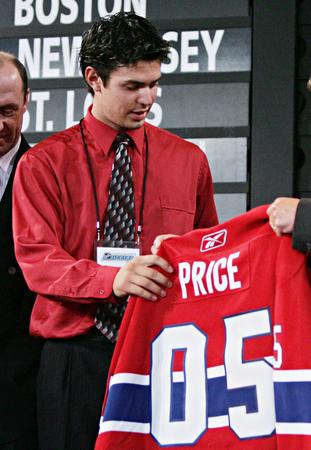
We'll follow Muir's lead and pass the torch to Luongo. Hopefully, the Canadian coaches will give Luongo (if he's starting) a bit of a leash so he can find his groove. As for our third goalie we're going to go with Carey Price. He's only had one season but we expect him to put up big numbers as the number one goalie in Montreal. We think his upside is much higher than Fleury's and he could be the goalie who takes over for Luongo in 2014 or 2018.


No matter how you put together this team they have to be the favourite to win it all in Vancouver. There will be a lot of competition from teams like Russia and Sweden but Canada is better equiped to take home the gold than any other country.

Bizarre Olympic Moment - Day 6

Each day of the 2008 Olympics we're going to find a bizarre clip or story from a past Summer Olympics. Today we'll look at Australian rower Bobby Pearce.

Bobby Pearce is one of Australia’s greatest Olympians. He won the gold in the single skulls in both the 1928 and 1932 Olympics. Although, he is one of the greatest rowers in history his legacy lies not with his records (his 1928 time was a world record until 1972) but for his gentile nature.

Bobby Pearce was consistently beating his competitors by thirty seconds or more in his pursuit for the gold medal. In the semi-finals he lined up next to Frenchman Victor Saurin in what would be one of the most bizarre moments in Olympics history. Just before his death Pearce relived the race that made him famous:

"I had beaten a German and a Dane in earlier heats and I was racing a Frenchman then I heard wild roars from the crowd along the bank of the canal. I could see some spectators vigorously pointing to something behind me, in my path. I peeked over one shoulder and saw something I didn't like, for a family of ducks in single file was swimming slowly from shore to shore. It's funny now, but it wasn't at the time ... I had to lean on my oars and wait for a clear course, and all the while my opponent was pulling away to a five length lead."

After coming to a full stop in a race any other rower would have been completely out of it, but Pearce’s remarkable ability allowed him not only to make up the difference but take a 30 second lead on his opponent. In the finals he claimed his first gold medal to complete his legacy.
(Sources: 101 Olympians and AOL Sports)


Take a look at the 16 most bizarre Olympic moments in history:

Day 1 - Eric "The Eel" Moussambani
Day 2 - Betty Robinson
Day 3 - Sally Robbins
Day 4 - Abebe Bilkila
Day 5 - 1972 USA Basketball team
Day 6 - Bobby Pearce
Day 7 - Byun Jong-il
Day 8 - Stella Walsh
Day 9 - Spanish Paralympic Basketball Team
Day 10 - Ingeborg Marx
Day 11 - Vanderlei de Lima
Day 12 - Hans-Jurgen Todt
Day 13 - Liu Changchun
Day 14 - Dorando Pietri
Day 15 - 1956 Hungarian Water Polo Team
Day 16 - 1960 Tunisian Modern Pentathlon Team

Bizarre Olympic Moment - Day 5

Each day of the 2008 Olympics we're going to find a bizarre clip or story from a past Summer Olympics. Today we'll look at the 1972 USA Basketball team.

In 1972 the best basketball nation in the world was undoubtedly the USA. The Americans hadn’t lost a single game since basketball was introduced in the Olympics in 1936 ... a span of 63 games. In the 1972 Munich Games the US met up with the perennial silver medalists, the Soviets. Both teams we undefeated in the lead up to the gold medal game, and all expected a close match.

The match lived up to expectations as it was back and forth all game. The Russians held the lead most of the game but the US continued to stay close. At halftime, the US were down by five points. The Russian lead increased to 10 with only ten minutes left to play.

The US weren’t dead yet. They mounted a massive comeback so they only trailed by a single point with 38 seconds left to play. The Russians fouled American Doug Collins hard as he was driving to the basket to sink the go-ahead basket ... giving Collins two free throws.

Collins had only three seconds on the clock so his two shots would likely decide the game. In one of the most pressure filled situations an athlete can be Collins sunk both shots to give the US a one point lead.

Now things get messy.

After the Soviets in-bounded the ball to make one last desperate play to score the referees stopped the game with only one second left. The Soviets believed they called for a time-out between Collins' free throws, which was never acknowledged by the referees.

In a surprising decision, the officials put three seconds back on the clock and the Russians got another shot to score the winning basket.

The Soviets in-bounded the ball again and failed to score. The buzzer sounded giving the Americans an apparent victory. As the US team started to celebrate they were told that due to a timekeeping error the play would have to be replayed a third time.

The head of the FIBA, Renato William Jones ruled that the clock had not been reset properly, and ordered that it should again show three seconds remaining. Jones was not an official and had no auithoriy to make this decision but after a conference with the officials, his decision stood.

The stunned Americans couldn’t believe what was happening:
"We couldn't believe that they were giving them all these chances," said U.S. forward Mike Bantom. "It was like they were going to let them do it until they got it right."
Soviet Alexander Belov (who fouled Collins with three seconds left) grabbed the full court pass from his teammate and scored the winning basket on a lay-up just as time ran out. The USSR had won the gold medal, ending the Americans impressive winning streak.

The U.S. filed a 51-page brief protesting the Russian victory. A panel rejected it by a 3-2 vote along Cold War lines, Poland, Hungary and Cuba supported the Soviet Union.

The players met after the game and all agreed never to accept the silver medal as they felt the officials had taken the game from them:

"That was the players talking. And they were saying they not accept the medal." said player Ed Ratleff. "To this day, I will not accept the medal. One player, Kenny Davis has it in his will to never accept it. My former wife tried to get me to accept it for the sake of our kids. I couldn't do it.

That's a rough way to end a 63 game losing streak.


(The information from this article was taken from ESPN and Press-Telegram)

Take a look at the 16 most bizarre Olympic moments in history:

Day 1 - Eric "The Eel" Moussambani
Day 2 - Betty Robinson
Day 3 - Sally Robbins
Day 4 - Abebe Bilkila
Day 5 - 1972 USA Basketball team
Day 6 - Bobby Pearce
Day 7 - Byun Jong-il
Day 8 - Stella Walsh
Day 9 - Spanish Paralympic Basketball Team
Day 10 - Ingeborg Marx
Day 11 - Vanderlei de Lima
Day 12 - Hans-Jurgen Todt
Day 13 - Liu Changchun
Day 14 - Dorando Pietri
Day 15 - 1956 Hungarian Water Polo Team
Day 16 - 1960 Tunisian Modern Pentathlon Team

Monday, August 11, 2008

Canada's Olympic Team...in 2010 (Part 1)

Alan Muir from SI.com has an article that sums up our feelings here at Waikiki Hockey pretty well:
"...the only Olympic event [Canadians] care about, truly and passionately, is
the 2010 hockey tournament."

Even though Waikiki Hockey is in full swing with our "Bizarre Olympic Moments" segment the Olympics is something we think about for two weeks every four years ... except for the hockey. That's a daily job for the true Canadian hockey fan.

Muir's article takes a look at who should be on the Canadian team for the 2010 Winter Games in Vancouver ... the fact that this article came out the week the 2008 Summer Olympics started makes it even better.

Today we're going to look at the forwards and tomorrow we'll look at the blue liners and goalies.

Muir's Picks

First Line:
Jarome Iginla, Sidney Crosby and Dany Heatley - This great combination of power and skill would give Canada the best line in the tourney (depending on what Russia does). Crosby is Canada's prize jewel and Iginla, our best power forward, had the highest point total for a Canadian this past year with 98. Heatley was off his game a bit in 2007-08 but can still score and mix it up with the best of them.

No arguments with Muir's picks for the top unit. We really like this line.

Second Line:
Rick Nash, Vincent Lecavalier, and Jonathan Toews - Many other Canadians had higher totals than Toews' 54 points last season, but he did it in only 64 games and is expected to get even better over the next few years. Lecavalier is a lock for the second line due to his experience with the Team Canada. Nash was a disappointment in the last Olympics, but he is a true scorer and should mesh well with Lecavalier.

We like Lecavalier and it would be tough to leave Nash off this team. Toews is a bit of a question mark for us. A very nice rookie season (cut short by injury) but we would like to see more experience from a second line player ... especially on Team Canada. Our feelings may change after a full season of watching Toews.

Third Line:
Mike Richards, Brenden Morrow and Shane Doan - As Muir points out, these three lack the prestige of some of Canada's other stars but they are all true leaders ... each wear the "C" for their team. All three can be pegged for around 70-80 points in an NHL season and all three have a feisty side ... Doan had 59 PIM's last year, Richards 76 and Morrow 105.

This is an interesting line. We like Doan but 2007-08 was his first season where he cracked 70 points. He's been a minus player three of the last four years and last season he really struggled. Richards broke through this season as he followed two seasons with 34 and 32 points with a monster 72 point season. We think Richards is a great player but we think Canada could pick somebody who is a bit more proven for this spot. Morrow also broke the 70 point barrier for the first time but he did it with a big plus-30 (he's only been a minus player once in his career). We'll add Morrow to our team but we think we can do better than having both Doan and Richards.

Fourth Line:
Eric Staal , Ryan Getzlaf, and Martin St. Louis - All three have enough skill to be a first or second line player for any other team in the tourney. This depth is why Canada is expected to take home the gold every year. Staal hasn't lived up to his 100 point season of three years ago, but has put up seasons of 70 and 82 points since, which isn't too shabby. St. Louis has Olympic experience and his speed should benefit him well on the Olympic sized surface, however, he has had an up-and-down career ... 94, 61, 104, and 83 points the last four years. Getzlaf has been improving each year in his short career and had a whopping 82 points last year.

We like all three of these. Muir get credit for putting them on the same line and we can't think of any reason this isn't a good idea.

Last Forward:
Joe Sakic or Sam Gagner
- Muir suggested Sakic may want to hold off retirement or make a comeback for the Olympics ... which will be played practically in his backyard. If Sakic can't make it, Muir thinks Sam Gagner would make a good addition for his quickness and shootout abilities.

Sakic's a bad idea. He's the sentimental pick and while it would be great to have him on the team after his long illustrious career ... he'll be 41 by the time the Olympics roll around. Why don't we bring back Lemieux, Yzerman and Gretzky while we're at it? This team needs to be as young as possible. As for Gagner, Canada has been burned in the shootout before so having him makes some sense but his 49 point, minus-21 rookie season isn't good enough for him to be on this squad. He'll need to break through this coming season to get this spot.

Who's Missing?
Joe Thornton is the big one. Muir makes a case that the second highest Canadian scorer last season with 96 points should not be on the team because he's not cut out for the high pressure environment. Other notables not on Muir's team are Jason Spezza (for reasons similar to Thornton's), Derek Roy and Ryan Smyth.

Who else is out there?

Want some NHL production on your team? Mike Ribeiro, Jason Pominville, Daniel Briere, J.P. Dumont, Paul Stastny, and Daymond Langkow all scored more than 65 points last year.

What about experience? Former Olympians like Todd Bertuzzi and Kris Draper won't be coming but what about Paul Kariya, Simon Gagne and Brad Richards? A bounce back season from any of them would put them back on the map.

You need speed? Players like Shawn Horcoff and Chris Kunitz may be invaluable on the big ice surface.

How about enthusiasm? Giving young prospects like Kyle Turris, Marc Staal, Corey Perry, Jordan Staal, Steven Stamkos or John Tavares a spot on the squad may benefit the Canadian team in the long term.

Still not enough? There's still Michael Cammalleri, Alex Tanguay, Nathan Horton, Patrice Bergeron and Patrick Marleau out there.

Where do you think Canada's "B" Team would finish?


Waikiki Hockey's Picks:

First Line:
Jarome Iginla, Sidney Crosby and Dany Heatley - we like what Muir did here so we're not touching it.

Second Line:
Rick Nash, Vincent Lecavalier and Martin St. Louis - Chemistry is a hard thing to get in a two week tournament. Vinny and Marty know each other well and should form a nice scoring line with Nash ... one of the only true scorers on this team.


Third Line:
Brendan Morrow, Joe Thornton and Mike Richards - We can't leave a 100 point scorer off this team. Thornton should enjoy passing to these two snipers and all three can throw the body around a bit. Also putting Thornton on the third line may take some pressure off of him. Thornton isn't really a checking center but he can hold his own. We ended up giving Richards the nod here over Doan, mostly due to age. (Doan will be 34, Richards will be 25 in 2010). If Richards or Morrow have an off-year/injury in 2009 or 2010 Doan could easily slide in here.


Fourth Line:
Eric Staal, Jason Spezza and Ryan Getzlaf
- Spezza has 87 points or more for three straight years ... that has to be worth something. Having Spezza play between two young guys like Staal and Getzlaf should help keep him focused and hopefully make him step up his game a bit and be a leader. It's a very young line but sometimes those lines have the most amount of passion and energy.


Last Forward:
Jonathon Toews
We hope Gretzky does what he did in 2006 ... name a few players who are up for the last spot and see who steps up. Put Steven Stamkos on the list with Jonathan Toews and Sam Gagner. We expect Toews will win the job in the end. He could easily step in for an ineffective Thornton or Spezza if need be.


Shane Doan, Simon Gagne, Daniel Briere available to fill in for any injuries or unexpected slumps on the reserve squad.

Some tough choices for Gretzky and company to make but it's nice to be in a situation where we have to leave out such quality players.

Tomorrow we look at the defence on the squad and who is going to start in goal ... so make sure to come back to Waikiki Hockey to see the rest of our squad.

Bizarre Olympic Moment - Day 4

Each day of the 2008 Olympics we're going to find a bizarre clip or story from a past Summer Olympics. Today we'll look at the Ethiopian Abebe Bilkila.

Abebe Bilkila wasn't on the original Ethiopian team for the 1960 Olympics in Rome. He had only run two marathons in his life so his exclusion wasn't surprising. When the team needed a last minute replacement they called on Bilkila.

In the marathon, his third ever, he ran an unbelievable race and broke the world record. But what makes this story truely bizarre is he set a new record in his bare feet. The shoes his team provided were making his feet hurt so he decided to run the entire 26 miles barefoot.

He was the first East African to win an Olympic golf medal and did the same four years later in Tokyo (this time with shoes and socks), setting another record in the process.

Bilkila's success blazed a trail for all other African long distance runners their success is due in large part to him.
(Some information from this article was taken from Spiked)

Take a look at the 16 most bizarre Olympic moments in history:

Day 1 - Eric "The Eel" Moussambani
Day 2 - Betty Robinson
Day 3 - Sally Robbins
Day 4 - Abebe Bilkila
Day 5 - 1972 USA Basketball team
Day 6 - Bobby Pearce
Day 7 - Byun Jong-il
Day 8 - Stella Walsh
Day 9 - Spanish Paralympic Basketball Team
Day 10 - Ingeborg Marx
Day 11 - Vanderlei de Lima
Day 12 - Hans-Jurgen Todt
Day 13 - Liu Changchun
Day 14 - Dorando Pietri
Day 15 - 1956 Hungarian Water Polo Team
Day 16 - 1960 Tunisian Modern Pentathlon Team

Sunday, August 10, 2008

Bizarre Olympic Moment - Day 3

Each day of the 2008 Olympics we're going to find a bizarre clip or story from a past Summer Olympics. Today we'll look at Australian Rower Sally Robbins.

Australian Sally Robbins was involved a bizarre moment in 2004 Olympics. Robbins was one of the nine members of Australia’s rowing team. The team was third through the first 1,000 metres but had dropped back to fifth with 500 metres remaining, three seconds behind the leaders. During the final 400 metres Robbins dropped her oar, allowing it to drag in the water, gave up and laid back on teammate Julia Wilson's lap. Australia, consequently, finished last, ten seconds behind the fifth place crew.


Robbins was dubbed “Lay Down Sally” by the Australian media and her teammates were not very supportive either:

"We had nine in the boat but only eight operating. I just want to stress there was not a technical problem. No seat broke. There was nothing wrong with boat," team mate Julia Wilson said.
Robbins, one of Australia's most technically sound rowers, claimed she was physically exhausted and was unable to physically move:

"Suddenly fatigue sets in and I just can't move, you know. It's a feeling of paralysis where you just hit the wall,"
Robbins claims of physical exhaustion were refuted by other rowers in the media who instead believed the "no row" was due to a lack of mental toughness as she had also stopped rowing on several other occassions, like at an event in 2002:

Robbins dropped her oar hundreds of metres short of the line as "Australia was blitzing the race, leading the entire field all the way," according to rower Rachel Taylor. "It was as about as sure a thing as you could get to having the world title in the bag, when with approximately 400 metres to go Sally Robbins stopped rowing.” (Sydney Morning Herald)

After the Olympics tensions were still very high. Back in Australia, during a parade to honour the Olympians, Robbins was slapped by teammate Catriona Oliver

Sally Robbins didn’t quit rowing after Athens. This year, she was performing strongly in camp and selection trials in hopes of making the 2008 Olympics. There was still deep-rooted suspicions in the squad that she was psychologically ill-equipped to race at Olympic level. Two of the squad went far as stating they would refuse to compete on the same team as Robbins, which may be one big reason she's not on the team.

Take a look at the 16 most bizarre Olympic moments in history:

Day 1 - Eric "The Eel" Moussambani
Day 2 - Betty Robinson
Day 3 - Sally Robbins
Day 4 - Abebe Bilkila
Day 5 - 1972 USA Basketball team
Day 6 - Bobby Pearce
Day 7 - Byun Jong-il
Day 8 - Stella Walsh
Day 9 - Spanish Paralympic Basketball Team
Day 10 - Ingeborg Marx
Day 11 - Vanderlei de Lima
Day 12 - Hans-Jurgen Todt
Day 13 - Liu Changchun
Day 14 - Dorando Pietri
Day 15 - 1956 Hungarian Water Polo Team
Day 16 - 1960 Tunisian Modern Pentathlon Team

Saturday, August 9, 2008

Bizarre Olympic Moment - Day 2

Each day of the 2008 Olympics we're going to find a bizarre clip or story from a past Summer Olympics. Today we'll look at runner Betty Robinson.

Yesterday, we showed you a bizarre moment from the pool at the 2000 Sydney Olympics. Today we go to the track and there will be no video clip as our moment is from the 1928 games in Amsterdam . It must be one of the most insane stories I’ve ever heard.

In 1928, Betty Robinson, was running for a train when the track coach at her high school saw her and convinced her to join the track team. Three weeks later she made her debut and finished second to the US record holder. In her next meet she equaled the world record of 12.0 seconds. In just her third meet she qualified for the American Olympic team, at just 16 years old.

The IOC was forced to include women’s events in the 1928 Olympics, making it the first time female track and field athletes were allowed to compete. Just four months after she was discovered and with only three meets under her belt, she sailed to Amsterdam to compete in the games.

The 100-meter race was first up. Robinson ended up winning a very close race … making her the very first female track medalist in Olympic history.

A nice story up to this point but this is where things get crazy.

In 1931, still a top athlete, Robinson was involved in a plane crash. The man who found her body thought she was dead, put her in his car boot and drove her to a mortician - but she was still alive, in a coma. She woke seven months later, and spent six months in a wheelchair. It took her two years to learn to walk normally again.

''If I had not been in such good physical condition,'' Robinson said, ''I would not have lived through it.''

Incredibly, she eventually returned to racing. Unable to bend her legs fully, she couldn't adopt a sprinter's crouch. But she could still run the relay, and in 1936 she won her second gold in the 4x100m. Completing one of the greatest comebacks in sports history.

(The information for this article was taken from articles in the New York Times and The Guardian.)

Take a look at the 16 most bizarre Olympic moments in history:

Day 1 - Eric "The Eel" Moussambani
Day 2 - Betty Robinson
Day 3 - Sally Robbins
Day 4 - Abebe Bilkila
Day 5 - 1972 USA Basketball team
Day 6 - Bobby Pearce
Day 7 - Byun Jong-il
Day 8 - Stella Walsh
Day 9 - Spanish Paralympic Basketball Team
Day 10 - Ingeborg Marx
Day 11 - Vanderlei de Lima
Day 12 - Hans-Jurgen Todt
Day 13 - Liu Changchun
Day 14 - Dorando Pietri
Day 15 - 1956 Hungarian Water Polo Team
Day 16 - 1960 Tunisian Modern Pentathlon Team

Friday, August 8, 2008

Bizarre Olympic Moment...Day 1

For each day of the Olympics we're going to find some bizarre clip to show you from a past Summer Olympics.

First up is Eric Moussambani of Equatorial Guinea, who was invited to the 2000 Olympics in Sydney as a wild card entry without reaching the qualifying standard. When he lined up for Heat #1 in the men’s freestyle he had never been in an Olympic sized pool, or even finished a whole 100 metre race.

His two competitors false started and were knocked out of the race. But Moussambani swam the 100 metres by himself…barely making it. He received loud cheers from the audience and the nickname “The Eel” for his performance. His time was 1 minute and 52 seconds…which is about how long it takes a top swimmer to swim 200 meters.


I have to agree with the commentator in that clip. Moussambani shouldn’t have really been there in the first place, but at least he was entertaining.

Take a look at the 16 most bizarre Olympic moments in history:

Day 1 - Eric "The Eel" Moussambani
Day 2 - Betty Robinson
Day 3 - Sally Robbins
Day 4 - Abebe Bilkila
Day 5 - 1972 USA Basketball team
Day 6 - Bobby Pearce
Day 7 - Byun Jong-il
Day 8 - Stella Walsh
Day 9 - Spanish Paralympic Basketball Team
Day 10 - Ingeborg Marx
Day 11 - Vanderlei de Lima
Day 12 - Hans-Jurgen Todt
Day 13 - Liu Changchun
Day 14 - Dorando Pietri
Day 15 - 1956 Hungarian Water Polo Team
Day 16 - 1960 Tunisian Modern Pentathlon Team